Sales: (844) 929-2485
Service: (450) 653-2485

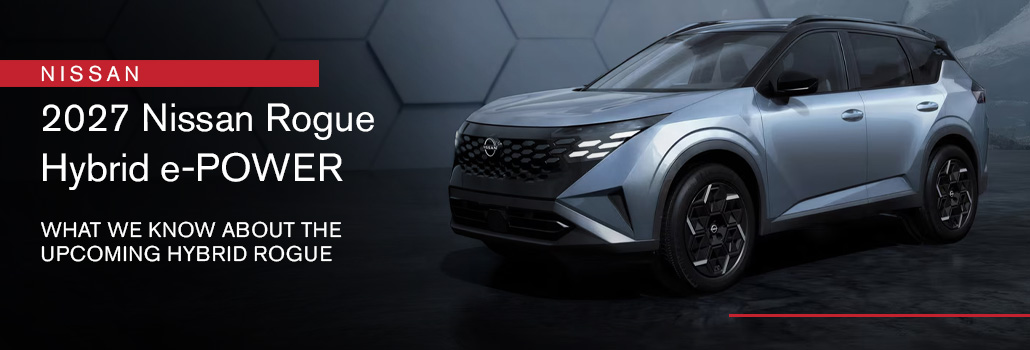
The 2027 Nissan Rogue Hybrid e-POWER is shaping up to be one of Nissan’s most important new entries in the compact SUV segment. For Quebec drivers who appreciate the Rogue’s versatility but want to reduce fuel consumption without necessarily switching to a fully electric vehicle or having to plug in every evening, this new powertrain could be a particularly appealing solution.
The change is significant. Rather than simply adding electric assistance to a conventional gasoline powertrain, Nissan is relying on its next-generation e-POWER technology. In this hybrid architecture, the wheels are driven by electric motors, while the gasoline engine is used primarily to generate the electricity needed to operate the system. The goal is to deliver a driving experience that feels more like an electric vehicle, without having to stop at a charging station.
For drivers in Saint-Basile-le-Grand, Saint-Bruno-de-Montarville and the surrounding area, the concept is especially promising. Daily commutes on the South Shore, city driving, highway trips, Quebec winters and long getaways could all be part of the next Rogue’s everyday environment.
One important point should be clarified, however: the 2027 Nissan Rogue Hybrid e-POWER is not yet on sale here, and some final specifications still need to be confirmed. The information presented here is therefore based on currently available preliminary details and early prototype drives. Specifications for the Canadian production model may differ.
While waiting for its arrival, drivers can discover the 2026 Nissan Rogue, as well as the 2026 Nissan Rogue Plug-In Hybrid, both currently offered in the lineup.
This is probably the most important question to understand, because the term “hybrid” now covers several very different technologies.
In a traditional hybrid vehicle, both the gasoline engine and the electric motor can contribute to driving the wheels. With the e-POWER system planned for the 2027 Nissan Rogue, Nissan takes a different approach: the gasoline engine is used primarily as a generator, while propulsion is provided by electricity.
The system shown so far uses a turbocharged 1.5-litre three-cylinder gasoline engine paired with a battery and two electric motors. One electric motor drives the front axle, while a second powers the rear axle.
In other words, when the driver presses the accelerator, the electric motors respond directly to the demand. The gasoline engine generates the electricity required by the system as needed rather than sending its power directly to the wheels.
This distinction could give the Rogue e-POWER a very different character from a conventional hybrid SUV. The instant response of the electric motors should provide smooth, natural acceleration, which can be especially appreciated when pulling away from intersections, passing and driving in everyday traffic.

Final combined-output figures for the 2027 Nissan Rogue Hybrid e-POWER have not yet all been officially confirmed for the Canadian market. The prototypes nevertheless provide a much clearer picture of the direction Nissan is taking.
The front electric motor is expected to produce approximately 201 horsepower and 244 lb-ft of torque, while the rear electric motor could generate approximately 134 horsepower and 144 lb-ft. These figures should not simply be added together to determine the vehicle’s total output. In an electrified system, combined power depends in part on the capabilities of the battery, inverter and electronic management system. Nissan will therefore need to confirm the official system output.
The 1.5-litre turbocharged three-cylinder engine plays a very different role from the engine in the 2026 Rogue. In the e-POWER system, its main job is to generate electricity.
This configuration also means that the future Rogue e-POWER should not use a conventional continuously variable transmission to transfer power from the gasoline engine to the wheels. Electric propulsion eliminates the traditional mechanical connection between the combustion engine, transmission and wheels.
For the driver, all of this technological complexity should instead feel simple: start the vehicle, select Drive and drive normally.
The use of two electric motors takes on particular importance in our region. With one motor at each axle, Nissan can electronically manage torque distribution between the front and rear.
This capability should allow the 2027 Rogue e-POWER to respond quickly to changing traction conditions. That is obviously an appealing feature when considering the winter conditions faced by drivers in Saint-Basile-le-Grand and across the South Shore.
A snow-covered Sir-Wilfrid-Laurier Boulevard, an icy highway on-ramp or a rain-soaked road does not require the same level of traction as dry pavement in July. Independent electronic management of the electric motors can quickly adjust the torque sent to the wheels.
Nissan is also working on torque management to better control body movement. The technology presented on the prototypes is designed in part to make deceleration and stops smoother by reducing forward pitch.
These may look like technical details on paper, but they can have a very real impact on everyday comfort.
Fuel economy will naturally be one of the main selling points of the 2027 Nissan Rogue e-POWER.
According to the preliminary information currently available, Nissan is targeting an improvement in energy efficiency of approximately 20% compared with the current gasoline Rogue. Fuel consumption of around 6 L/100 km has been mentioned, but this figure should be treated as a target or estimate until official Canadian ratings are published.
For reference, the 2026 Nissan Rogue currently posts ratings that can be around 8.3 L/100 km in the city and 6.8 L/100 km on the highway, or approximately 7.6 L/100 km combined for certain versions.
The potential efficiency gain from e-POWER could be especially interesting for someone who drives many kilometres each year between Saint-Basile-le-Grand, Saint-Bruno, Beloeil, Sainte-Julie, Boucherville and Montreal.
However, real-world testing in Quebec conditions will be needed before drawing any final conclusions. Temperature, cabin heating, winter tires, speed and the type of driving can all affect the fuel consumption of an electrified vehicle.

Since the Rogue e-POWER is not yet available, the 2026 Nissan Rogue remains the most concrete comparison point for a driver shopping today. Here are the main technical differences that are known or anticipated.
| Feature | 2026 Nissan Rogue | 2027 Nissan Rogue Hybrid e-POWER |
| Powertrain | 1.5 L turbocharged 3-cylinder | 1.5 L turbocharged 3-cylinder used primarily as a generator |
| Electrification type | None | e-POWER hybrid |
| Wheel propulsion | Gasoline engine through the transmission | Electric motors |
| Transmission | Xtronic continuously variable transmission | No conventional CVT connecting the combustion engine to the wheels |
| Drivetrain | All-wheel drive available | Two electric motors, front and rear, based on preliminary information |
| Front electric motor | No | Approximately 201 hp and 244 lb-ft |
| Rear electric motor | No | Approximately 134 hp and 144 lb-ft |
| Combined output | Depends on the current powertrain | To be confirmed |
| Hybrid battery | No | Approximately 2.1 kWh based on preliminary information |
| Charging station required | No | No |
| Combined fuel consumption | Approximately 7.6 L/100 km on certain trims | Approximately 6 L/100 km anticipated |
| One-pedal driving | Not comparable to an EV | Planned |
| Model year | 2026 | 2027 |
| Availability | Available | Upcoming; final Canadian specifications to be confirmed |
The comparison highlights the distinctive philosophy behind e-POWER. Nissan is not simply trying to turn the Rogue into a hybrid. The brand wants to give it some of the driving feel of an electric vehicle while retaining the speed and convenience of refuelling with gasoline.
No. That is precisely one of the fundamental differences between the future Rogue e-POWER and a Rogue Plug-In Hybrid.
Drivers will not normally need to connect their Rogue e-POWER to a charging station. The gasoline engine produces the energy required by the system, while regenerative braking also helps recharge the battery.
This setup could appeal to drivers who want to reduce fuel consumption without changing their habits around charging.
A plug-in hybrid, however, follows a different approach. It has a much larger battery and can travel a certain distance using electricity stored through external charging. For an owner with a home charging station who mainly makes short daily trips, this solution can be particularly attractive.
You can already discover the Nissan Rogue Plug-In Hybrid to better understand this alternative.
e-POWER technology is about more than fuel savings. It could transform the very personality of the Nissan Rogue.
An electric motor delivers torque immediately. It does not need to wait for a transmission to select a gear or for the combustion engine to reach a certain rpm. This characteristic is one reason electric vehicles generally provide such smooth accelerator response.
The Rogue e-POWER aims to reproduce that feeling.
Early impressions from prototype drives describe a relatively unobtrusive gasoline engine and pleasant electric response. Nissan has also worked on integrating the engine, inverter and reduction gear system to make the overall package more compact and better insulated.
One-pedal driving will be another noteworthy feature. The driver will be able to use regenerative deceleration to slow the vehicle significantly when lifting off the accelerator, even allowing the vehicle to come to a complete stop in the mode designed for that purpose.
In heavy Montreal traffic or South Shore congestion, this type of driving can reduce the number of movements between the accelerator and brake pedals.
The Rogue owes much of its success to its family-friendly versatility. Electrification therefore cannot come at the expense of interior space.
Since final Canadian cargo-volume specifications for the 2027 Rogue e-POWER have not yet been published, it would be premature to announce a precise capacity. The next Rogue should nevertheless remain a family-oriented compact SUV, and the new generation is expected to be slightly larger.
The integration of a small battery is a potential advantage here. Unlike a plug-in hybrid, e-POWER does not require a battery large enough to travel dozens of kilometres on electricity alone. The battery can therefore remain relatively compact, making it easier to integrate into the vehicle.
For a family in Saint-Basile-le-Grand, this is an important consideration. A Rogue needs to accommodate groceries, sports equipment, weekend luggage, a stroller and the many items that come with family travel.
We will be able to compare cargo volume behind the second row and maximum cargo capacity more precisely once Nissan publishes the Canadian specifications.

The announced arrival of the 2027 Nissan Rogue Hybrid e-POWER does not necessarily mean you need to wait before changing vehicles.
The 2026 Nissan Rogue remains an especially versatile option for drivers who want to take delivery of a compact SUV now. Its 1.5-litre turbocharged three-cylinder engine is paired with an Xtronic continuously variable transmission, and several all-wheel-drive versions are offered.
The lineup includes S, SV, SV Dark Armor, Rock Creek and Platinum configurations, allowing buyers to prioritize value, styling, adventure-oriented features or a higher level of equipment.
Drivers who are already ready to move to an electrified solution can also consider the 2026 Rogue Plug-In Hybrid.
The easiest way is to browse our new Nissan vehicle inventory to see the Rogue models currently offered at St-Bruno Nissan.
A hybrid SUV needs to be evaluated based on the owner’s everyday reality. That is exactly what makes the Rogue e-POWER interesting for our region.
In Saint-Basile-le-Grand, many drivers combine short local trips with longer commutes to Saint-Bruno-de-Montarville, Sainte-Julie, Beloeil, Boucherville, Longueuil or Montreal. The vehicle can therefore move from city traffic to highway driving in the same day.
e-POWER aims to bring together two worlds. At low speeds and in traffic, electric propulsion should deliver smooth and quiet response. On the highway, the gasoline engine can continue generating the necessary energy without requiring the driver to plan a charging stop.
This simplicity could be particularly appealing to drivers who do not have a home charging station or who are not yet ready to switch to a fully electric vehicle.
And when winter arrives, the anticipated use of two electric motors and electronic torque management at all four wheels becomes especially relevant for Quebec roads.
The 2027 Nissan Rogue e-POWER is expected to be one of the next major additions to the Rogue lineup. An arrival beginning in fall 2026 has been mentioned for this new hybrid generation, but the exact launch schedule at Canadian dealerships may change. For the latest information about availability in Saint-Basile-le-Grand, you can contact St-Bruno Nissan.
Nissan is targeting a significant improvement compared with the current gasoline Rogue, and fuel consumption of around 6 L/100 km is anticipated. This figure remains preliminary, however. Official Canadian ratings and testing in Quebec conditions will be needed to determine its real-world fuel consumption.
No. The Rogue e-POWER is a non-plug-in hybrid. Its gasoline engine primarily acts as a generator to produce the electricity required by the electric motors. It therefore does not require daily connection to a charging station.
The Rogue e-POWER produces its electricity on board and does not need to be plugged in. A plug-in hybrid has a larger battery that can be charged at a charging station, allowing part of your driving to be completed on electricity. Both technologies aim to reduce fuel consumption, but they are designed for different driving habits.
The prototypes shown use two electric motors, one at the front and one at the rear, allowing electronic torque management at all four wheels. The exact configurations that will be offered in Canada still need to be confirmed by Nissan.
Nissan has not yet confirmed a final combined-output figure for the Canadian model. Preliminary information points to a front electric motor producing approximately 201 horsepower and a rear motor producing approximately 134 horsepower. These figures should not be added together directly, since total available power depends on the entire electrical system.
Yes. St-Bruno Nissan currently offers the 2026 Nissan Rogue as well as electrified options depending on availability. You can browse the new Nissan vehicle inventory to see the vehicles currently available.
The 2027 Nissan Rogue Hybrid e-POWER could represent much more than the arrival of a new powertrain in the lineup. With its series-hybrid architecture, two electric motors and targeted reduction in fuel consumption, it offers an original approach between a traditional gasoline SUV and a fully electric vehicle.
For drivers in Saint-Basile-le-Grand, Saint-Bruno-de-Montarville, Beloeil, Sainte-Julie, Boucherville, Longueuil and Montreal’s South Shore, this formula could be particularly relevant: enjoy an electric-like driving experience and lower fuel consumption without having to make charging part of your daily routine.
We will need to wait for the final Canadian specifications to learn its combined output, official fuel consumption, cargo volume, trims, equipment and price.
You do not need to wait for the 2027 model to discover the Rogue family, however. St-Bruno Nissan invites you to explore the 2026 Nissan Rogue, discover the Rogue Plug-In Hybrid or browse our current new-vehicle inventory.
Found a configuration that interests you? You can request a quote or book a test drive. To learn more about the future 2027 Rogue e-POWER and its eventual arrival in Quebec, contact the St-Bruno Nissan team in Saint-Basile-le-Grand.